

Stray Lines. Found Wisdom.
Last Update: 09-27-2026, 11:19 a.m., CDT
Amplification
“Freud theorized that our lives are a project of tempering and downgrading desire, an ongoing compromise between fantasy and reality. By contrast, [Adam] Phillips writes that the Rortian seeks ‘the most inclusive conversation possible’ with our unconscious selves, one that ‘will further and proliferate our purposes and increase our sense of autonomy.’ Strikingly, we should try to ‘proliferate’ our purposes, not just advance them. If the father of talk therapy aimed to mitigate our wanting’s intensity, [Richard] Rorty sought to intervene in its monomania.”
—Katy Waldman, “Listen to Yourselves,” The New Yorker (March 23, 2026)
Honesty
“[Ray] Robinson, hardly convinced he was riding the subway with a future broadcasting titan, and trying not to sound condescending, kibitzed him, ‘So I guess that means you’ll be the biggest asshole of all.’
“[Howard] Cosell quickly replied, without a hedge, ‘Yes, I will.’
“Robinson, with a wry grin, adds the mandatory footnote.
“‘I don’t think anyone would disagree that he was absolutely right,’ he says. ‘Because, in the end, that is exactly what he became.’
“Not that Cosell had a problem with that. To get to where he wanted, he knew he would have to be the world’s biggest posterior aperture.”
—Mark Ribowsky, Howard Cosell: The Man, the Myth, and the Transformation of American Sports, p. 27 (2012)
Aliveness
Let us not waste our time in idle discourse! Let us do something, while we have the chance … at this place, at this moment of time, all mankind is us, whether we like it or not. Let us make the most of it before it is too late! Let us represent worthily for once the foul brood to which a cruel fate consigned us! What do you say?
—Samuel Beckett, Waiting for Godot, as delivered by Vladimir, played by David Strathairn, during a production at the Guthrie Theater (September 18, 2026)
Acceptance
If you can feel your heartbeat
You’re not done yet, you can’t be
If it hurts, it’s workin’
There is love enough
For you and me
—The Midnight, “Heartbeat,” Heroes (2022)
Perspective
“Everything is expensive whether it’s recession times or not, because life takes energy. You’ll look at that energy cost even more than dollar cost, especially when emotions are involved. Emotions can be the most expensive energy expenditure of all.”
—Holiday Mathis, Horoscope, Minnesota Star Tribune (September 10, 2026)
Acceptance
what matters most is
how well you
walk through the
fire.
—Charles Bukowski, “How’s Your Heart,” The Pleasures of the Damned: Poems, 1951-1993 (2007)
Environment
“Big version: Live in the house that exists in your imagination. Currently achievable version: Choose one corner of your present home and give it the color, comfort and character of that dream. The process is addictive, and results will spread throughout your space.”
—Holiday Mathis, Horoscope, Minnesota Star Tribune (August 31, 2026)
Kismet
Happiness. It comes on
unexpectedly. And goes beyond, really,
any early morning talk about it.
—Raymond Carver, “Happiness,” as republished in Good Poems, edited by Garrison Keillor (2002)
Stewardship
“In fact, for the purposes of the book he had become Lombardi. In the end, after all, this was Lombardi’s book, written in the first person. The word on the page would be ‘I,’ meaning Lombardi. For the book to work, he had to capture how Lombardi thought, talked and felt. [W.C.] Heinz had the proper disposition for the task. He was not obsessed or temperamental as his subject, but he got along with Lombardi and thought he understood the coach and appreciated his greatness, despite his apparent flaws. ‘The thing that hit me with Lombardi and that we agreed on right away is that if you are gifted you have a moral responsibility to fulfill that gift as best you can,’ Heinz reflected later. ‘I always believed it and Lombardi believed it all the way.’”
—David Maraniss, When Pride Still Mattered: A Life of Vince Lombardi, p. 318 (1999)
Maturity
“You will become way less concerned with what other people think of you when you realize how seldom they do.”
—David Foster Wallace, Infinite Jest (1996), cited August 14, 2026, in Waking Up (app)
Strength
“We were not born to sue, but to command.”
—Shakespeare, Richard II (Act 1, Scene 1), as delivered by King Richard during a production at the Guthrie Theater, April 27, 2024
The Numinous
“The same energy which inspired the rooks, the ploughmen, the horses, and even, it seemed, the lean bare-backed downs, sent the moth fluttering from side to side of his square of the window-pane. One could not help watching him. One was, indeed, conscious of a queer feeling of pity for him. The possibilities of pleasure seemed that morning so enormous and so various that to have only a moth’s part in life, and a day moth’s at that, appeared a hard fate, and his zest in enjoying his meagre opportunities to the full, pathetic. He flew vigorously to one corner of his compartment, and, after waiting there a second, flew across to the other. What remained for him but to fly to a third corner and then to a fourth? That was all he could do, in spite of the size of the downs, the width of the sky, the far-off smoke of houses, and the romantic voice, now and then, of a steamer out at sea. What he could do he did. Watching him, it seemed as if a fibre, very thin but pure, of the enormous energy of the world had been thrust into his frail and diminutive body. As often as he crossed the pane, I could fancy that a thread of vital light became visible. He was little or nothing but life.”
—Virginia Woolf, “The Death of the Moth” (1941)
Conversation
“So why don’t people talk more? [Behavioral psychologist Nicholas] Epley continued his research and came up with an answer to the mystery: We don’t start conversations because we’re bad a predicting how much we’ll enjoy them. We underestimate how much others want to talk; we underestimate how much we will learn; we underestimate how quickly other people will want to go deep and get personal. If you give people a little nudge, they will share their life stories with enthusiasm. As I hope I’ve made clear by now, people are eager, often desperate, to be seen, heard, and understood. And yet we have built a culture, and a set of manners, in which that doesn’t happen. The way you fix that is simple, easy, and fun: Ask people to tell you their stories.”
—David Brooks, How to Know a Person: The Art of Seeing Others Deeply and Being Deeply Seen (2023)
Release
These are my feet
These are my hands
These are my children
This is my demand
Bring down the angels
Cast them from my sight
I never want to see
A million suns at midnight
Your hands are empty
The streets are empty
You can’t control us
You can’t control us anymore
—Sting, “When the Angels Fall,” Soul Cages (1991)
Depth
“The movie works smoothly and deeply to achieve its effects, which have to do with more than this night or this feast. The surprises in the plot involve not only secret romance but heartbreak and long-held frustration, for if genius is great, it is nevertheless not easy to be genius’ brother. By the end of the movie, we have been through an emotional and a sensual wringer, in a film of great wisdom and delight.”
—Roger Ebert, “Big Night,” RogerEbert.com (September 27, 1996)
Love
“Caterpillars are produced immediately from the egg; they are furnished with several pairs of feet, and have the shape and appearance of a worm. They contain the embryo of the perfect insect, inclosed within a muscular envelop, which is thrown off, when the insect enters the nymph or chrysalis state, in which it remains for sometime as if inanimate. It then throws off its last envelop, and emerges a perfect insect.”
—Noah Webster, Noah Webster’s 1828 Dictionary
Emotions
“One of the commonest and most generally accepted delusions is that every man can be qualified in some particular way — said to be kind, wicked, stupid, energetic, apathetic, and so on. People are not like that. We may say of a man that he is more often kind than cruel, more often wise than stupid, more often energetic than apathetic or vice versa; but it could never be true to say of one man that he is kind or wise, and of another that he is wicked or stupid. Yet we are always classifying mankind this way. And it is wrong. Human beings are like rivers; the water is one and the same in all of them but every river is narrow in some places, flows swifter in others; here it is broad, there still, or clear, or cold, or muddy or warm. It is the same with men. Every man bears within him the germs of every human quality, and now manifests one, now another, and frequently he is quite unlike himself, while remaining the same man.”
—Leo Tolstoy, as quoted by David Brooks, How to Know a Person: The Art of Seeing Others Deeply and Being Deeply Seen (2023)
Failure
“I’m always blown away by the NFL and just the importance of each and every game. You lose three in a row, and you’ve basically gone a month without winning a game. And (in the NBA) it’s different in that there’s so many games and so losses are … more routine. I mean, even the best teams lose, you know, quite a few games every year. So, to me, the way I see it, the joy has to be there when you’re losing. It shouldn’t feel that different at practice the day after a loss than it does the day after a win. The consistency of that value is important to me.”
—Steve Kerr, as quoted by Zach Berman, “How Eagles Coach Nick Sirianni Studied Warriors Coach Steve Kerr to Celebrate ‘Joy’ Amid Scrutiny,” The Athletic (January 6, 2026)
Aggression
“You can’t win with a perfect defense.”
—Eumaeus, played by John Leguizamo, The Odyssey (2026 movie version)
Allowance
“You're a man who needs to control his fate. But you cannot control this. You must give yourself to the storm, give yourself to Poseidon. And take your punishment. Give up the fight, give up control and live. It is a leap of faith you haven't yet made, Odysseus.”
—Calypso, played by Charlize Theron, The Odyssey (2026 movie version)
Transcendence
One love that never fades away
Our love
This love will light the world on its way
—Michael McDonald, “Our Love,” No Lookin’ Back (1985)
Independence
“Harold thought that some people probably lived their whole lives just for other people’s reaction.
“Like everybody who has ever been in show business.”
—Steven Wright, Harold, p. 216 (2023)
Acceptance
“I think very few people are completely normal, really, deep down in their private lives.”
—Noel Coward, Private Lives, as delivered by Amanda, played by Laura Odeh, during a production at the Guthrie Theater (July 22, 2026)
Love
everything is clear in the rear view mirror
the coast highway and the golden hour
only love
nothing was lost
everything fits when you tell your story
the blurry portraits in the halls of former lovers
gone
but nothing was lost
you’ll always be a part of me
you gave me a song to sing
—The Midnight, “Memories,” Endless Summer (2016)
Imperturbability
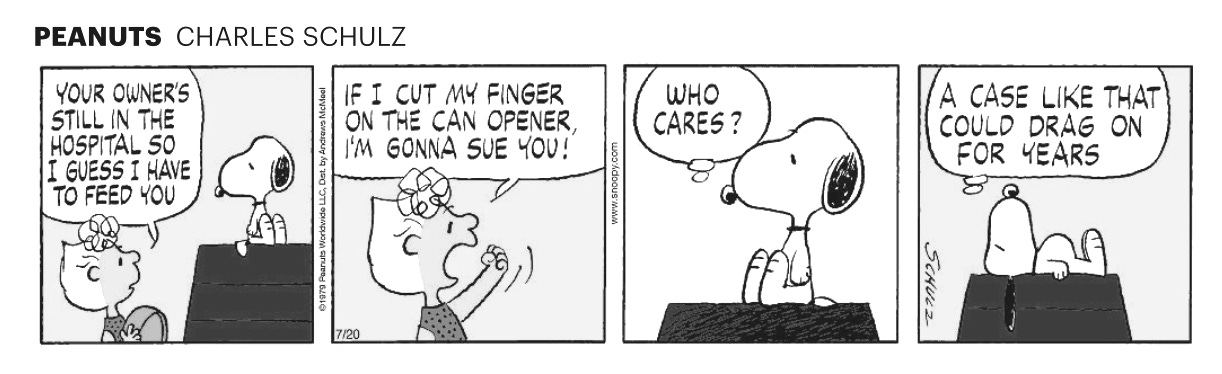
—As published in the Minnesota Star Tribune (July 20, 2026)
Solitude
“He built a small house, called a cocoon, around himself. He stayed inside for more than two weeks …”
—Eric Carle, The Very Hungry Caterpillar (1987 edition)
Craft
“Writing a first draft is painful work for any writer, whether it moves like lightning or like glue. [John] McPhee spends twelve-hour stints at his office, not writing constantly, but ‘concentrating’ and distilling his research into prose. Some authors overwrite and later boil down; he culls before ever typing a phrase. He likens this method to the sport of curling, where great effort is spent sweeping the ice clean to advance each shot. With writing comes the need for endless decisions, mostly on what not to say, what to eliminate. The process is nerve-racking and lonely.”
—William H. Howarth, “Introduction,” The John McPhee Reader (1992)
Attention
“Your focus is your superpower. It’s not about doing more than everybody else but about doing the exact thing that matters. You learn fast, study deeply, and work without distraction. Your attention carries more weight than words ever could.”
—Holiday Mathis, Horoscope, Minnesota Star Tribune (February 18, 2026)
Self-Awareness
“Philip found that he was able to observe with curiosity the condition he had been in during the last few weeks. He analyzed his feelings with interest. He was a little amused at himself. One thing that struck him was how little under those circumstances it mattered what one thought; the system of personal philosophy, which had given him great satisfaction to devise, had not served him. He was puzzled by this.”
—M. Sommerset Maugham, Of Human Bondage (Penguin Classics edition, 1992)
Identity
“7,000 RPM. That’s where you meet it. You feel it coming. It creeps up on you, close in your ear. Asks you a question. The only question that matters: Who are you?”
—Carroll Shelby, played by Matt Damon, Ford v Ferrari (2019)
Trust
I’m fading out of sight
My wheels are the only sound
Runnin’ at the speed of light
I can’t slow down
Out on the open road
Racing to beat the night
No matter where I go
Guess I’ll get there all right
—Michael McDonald, “No Lookin’ Back,” No Lookin’ Back (1985)
Unvarnished
When I think about tomorrow, I can’t wait to
Stir it, got to shake it up — now
—Patti LaBelle, “Stir It Up,” Beverly Hills Cop (1985)
Patience
“The ripest fruit first falls.”
—Shakespeare, Richard II (Act 2, Scene 1), as delivered by King Richard during a production at the Guthrie Theater (April 27, 2024)
Acceptance
“Happiness mattered as little as pain. They came in, both of them, as all the other details of his life came in, to the elaboration of the design. He seemed for an instant to stand above the accidents of his existence, and he felt that they could not affect him again as they had done before. Whatever happened to him now would be more motive to add to the complexity of the pattern, and when the end approached he would rejoice in its completion. It would be a work of art, and it would be nonetheless beautiful because he alone knew of its existence, and with his death it would at once cease to be. Philip was happy.”
—M. Sommerset Maugham, Of Human Bondage (Penguin Classics edition, 1992)
Opportunity
“You can see the course of life as checking boxes. When you have anything that happens, good or bad, like the bad thing that happened to me, you have boxes to check. How are you going to bounce back from this? Are you going to get down on yourself and collapse, or are you going to deal with the situation to use it (as) much as you can?”
—Victor Wembanyama, as quoted by Jared Weiss, “Victor Wembanyama Wanted to Create a Spurs Fan Group: The Jackals Became So Much More,” The Athletic (January 15, 2026)
Clarity
“Describing how NFL football transpires on a play-by-play basis is like trying to explain the incremental mechanics of a nuclear reactor. The levels of editing are so unlike every other sport that there’s a tendency to talk around it, almost as if what’s transpiring on the field were somehow a surprise to everyone involved. But there are few surprises in football, and when there are, it usually means someone fucked up. The most elementary of plays — a handoff to the tailback, running between the right tackle and the tight end — is the the final manifestation of a decision made by an offensive coordinator sitting in a glass booth hundreds of feet above the field, relayed to the sideline over a landline phone, and transmitted into the wireless headset of the quarterback. The description of the play is converted into code, decrypted with the assistance of the QB’s laminated wristband. The quarterback can then run the play or call an audible, depending on how the defense is aligned (a calculation made by the opposing team’s defensive coordinator, generally operating from the sideline but receiving real-time tactical data from a different assistant watching in a different glass booth). Whom each lineman blocks is dictated by the defensive configuration, with every foreseeable scenario rehearsed in practice hundreds of times. The decision to run the tailback off-tackle is an extension of the overall game plan, built from hours of film study and predictive analytics. The play call is rooted in a conceptual philosophy, and the players involved have often been acquired because their skillset matches that philosophy.
“Does that sound needlessly convoluted? If so, here’s the insane part: My explanation in the previous paragraph is so oversimplified that is doesn’t reflect a sliver of how staged-managed the process truly is. It’s not that basketball is jazz and football is anti-jazz, or that basketball is jazz and football is prog rock. It’s more that basketball aspires to be jazz and football aspires to be petroleum engineering. Which, I am fully aware, sounds terrible. Dave Hickey would see this concentration of control as the worst thing about football, in terms of its humanity, and that every dehumanizing aspect of football culture originates from this connection to hierarchical control. But if that is indeed the case, there’s almost no need to further explain why football is so metaphorically important to society. There is no need to dissect why so many working-class Americans relate to a game built on executive control, or why the institution of football has managed to prosper in an era when public faith in all other forms of institutional power has declined.
“Don’t see the problem as a problem. See the problem as evidence of meaning.”
—Chuck Klosterman, Football (2026)
Inspiration
“[America] is the first nation in the world that was ever established on the basis of reason instead of simply warfare.”
—Joseph Campbell, The Power of Myth, p. 31 (1991)
Forward
Just say yes
Just say there’s nothing holding you back
It’s not a test, nor a trick of the mind
Only love
—Snow Patrol, “Just Say Yes,” Up To Now (2009)
Forward
There I go
Turn the page
—Bob Seger, “Turn the Page,” ‘Live’ Bullet (1976)
Adult Honesty
“Popularity was never my Mistress, nor was I ever, or shall I ever be a popular Man. This Book will make me unpopular. But one Thing I know a Man must be Sensible of the Errors of the People, and upon his Guard against them, and must run the risque (sic) of their Displeasure Sometimes, or he will never do them any good in the long run.”
—John Adams, writing to friend James Warren, as quoted in Fears of a Setting Sun: The Disillusionment of America’s Founders by Dennis C. Rasmussen, p. 117 (2021)
Wit
“Empty vessels make the loudest sound.”
—Shakespeare, Henry V (Act 4, Scene 4), as delivered by Boy during a production at the Guthrie Theater (May 12, 2024)
Aliveness
“Feeling the stress, feeling the passion, feeling the fans — it was a privilege. You’re put in a situation where you can feel alive. Not a lot of people get that type of adrenaline, that type of fear, that type of pressure. And how I handled it was just to take it in. Don’t be afraid of feeling feelings.
“Embrace it. Take the stress and all that as a badge of honor. Something that a lot of people aren’t able to do.
“That’s how I see suffering. I see it as a badge of honor.”
—Eric Gagne, former Los Angeles Dodgers pitcher, as quoted by Jayson Jenks in “Peak: The Mental Side of Sports” newsletter, The Athletic (June 25, 2026)
Energy
“You fucking people.”
—Col. Nathan R. Jessep (played by Jack Nicholson), A Few Good Men (1992)
Amor Fati
Until you wake up one morning
And walk out without fеar
—The Midnight, “The Right Way,” Syndicate (2025)
Rootedness
“Listen, Jake,” he leaned forward on the bar. “Don’t you ever get the feeling that all your life is going by and you’re not taking advantage of it? Do you realize you’ve lived nearly half the time you have to live already?”
“Yes, every once in a while.”
“Do you know that in about thirty-five years more we’ll be dead?”
“What the hell, Robert,” I said. “What the hell.”
“I’m serious.”
“It’s one thing I don’t worry about,” I said.
“You ought to.”
“I’ve had plenty to worry about one time or other. I’m through worrying.”
“Well, I want to go to South America.”
“Listen, Robert, going to another country doesn’t make any difference. I’ve tried all that. You can’t get away from yourself by moving from one place to another. There’s nothing to that.”
“But you’ve never been to South America.”
“South America hell! If you went there the way you feel now it would be exactly the same. This is a good town. Why don’t you start living your life in Paris?”
—Ernest Hemingway, The Sun Also Rises (1926)
Trust
“To be an artist means not to count or reckon but to ripen like the tree that does not force its sap and, trustingly, stands through the storms of spring without the fear that summer will not come. It will come. But it comes only to the patient ones, who stand there with eternity stretching around them, quiet, vast, and free of worry. I learn this every day, learn it amid struggle, for which I am thankful. Patience is all!”
—Rainer Maria Rilke, Letters to a Young Poet (Anita Barrows and Joanna Macy translation, 2021)
Triumph
“Looks like we made it.”
—Barry Manilow, “Looks Like We Made It,” This One’s For You (1976)
Self-Allegiance
“A lot of people wanted to jump on board and give their opinions, and sometimes you listen too much. You can lose your own instinct in the process. So I learned that while you need to listen and have a degree of collaboration, ultimately you have to use your gut to make the right decisions.”
—Sean McDermott, as quoted by Dan Pompei, “Sean McDermott Has Evolved Over 9 Years as Bills Coach: One Thing Remains the Same,” The Athletic (January 7, 2026)
The Gift
“One way to say ‘thank you’ is to enjoy yourself. In fact, the pleasure you take may be the purest form of gratitude there is. Today, your delight itself will be a form of prayer and praise.”
—Holiday Mathis, Horoscope, Minnesota Star Tribune (October 12, 2025)
Selectivity
“I believe, however, every one will agree with me, that, notwithstanding this resemblance, delicacy of taste is as much to be desired and cultivated as delicacy of passion is to be lamented, and to be remedied, if possible. The good or ill accidents of life are very little at our disposal; but we are pretty much masters of what books we shall read, what diversions we shall partake of, and what company we shall keep. Philosophers have endeavoured to render happiness entirely independent of every thing external. That degree of perfection is impossible to be attained: But every wise man will endeavour to place his happiness on such objects chiefly as depend upon himself: and that is not to be attained so much by any other means as by this delicacy of sentiment. When a man is possessed of that talent, he is more happy by what pleases his taste, than by what gratifies his appetites, and receives more enjoyment from a poem or a piece of reasoning than the most expensive luxury can afford.
“Whatever connexion there may be originally between these two species of delicacy, I am persuaded, that nothing is so proper to cure us of this delicacy of passion, as the cultivating of that higher and more refined taste, which enables us to judge of the characters of men, of compositions of genius, and of the productions of the nobler arts. A greater or less relish for those obvious beauties, which strike the senses, depends entirely upon the greater or less sensibility of the temper: But with regard to the sciences and liberal arts, a fine taste is, in some measure, the same with strong sense, or at least depends so much upon it, that they are inseparable. In order to judge aright of a composition of genius, there are so many views to be taken in, so many circumstances to be compared, and such a knowledge of human nature requisite, that no man, who is not possessed of the soundest judgment, will ever make a tolerable critic in such performances. And this is a new reason for cultivating a relish in the liberal arts. Our judgment will strengthen by this exercise: We shall form juster notions of life: Many things, which please or afflict others, will appear to us too frivolous to engage our attention: And we shall lose by degrees that sensibility and delicacy of passion, which is so incommodious.”
—David Hume, “Of the Delicacy of Taste and Passion,” Essays: Moral, Political, and Literary (1777)
Control
“My formula for greatness in a human being is amor fati: that one wants nothing to be different, not forward, not backward, not in all eternity. Not merely bear what is necessary, still less conceal it — all idealism is mendaciousness in the face of what is necessary — but love it.”
—Friedrich Nietzsche, On the Genealogy of Morals / Ecce Homo (1908)
Autonomy
“Outer reforms are useless if the inner state is not changed. Success is gained not by imitating the outer actions of the successful but by right inner actions and inner talking.”
—Neville Goddard, Awakened Imagination (Tarcher Cornerstone Editions, 2012)
Ease
“OK. Here’s another one my dad would say, ‘Slow is smooth. Smooth is fast.’”
—Sonny Hayes (played by Brad Pitt), FI: The Movie (2025)
Presence
“Of course, it’s no accident that things are more likely to go your way when you stop worrying about whether you’re going to win or lose and focus your full attention on what’s happening right this moment.”
—Phil Jackson (and Hugh Delehanty), Sacred Hoops: Spiritual Lessons of a Hardwood Warrior (1995)
Patience
“Let every impression and every kernel of a feeling complete itself in the dark, in the unsayable, unconscious, unreachable by the daylight mind. With humility and patience, await the hour when a new clarity is delivered. This is what it means to be an artist, in your understanding as well as in your creating.”
—Rainer Maria Rilke, Letters to a Young Poet (Anita Barrows and Joanna Macy translation, 2021)
Ease
“You won’t have to fight for anything. What’s yours will be freely given or returned to you. Argument and persuasion are unnecessary uses of your energy today as well. You’ll simply stand in your own truth, and everything will work out.”
—Holiday Mathis, Horoscope, Minnesota Star Tribune (February 15, 2026)
Clarity
“After a big victory in San Francisco, the Patriots were enjoying the flight home.
“‘We’re standing up, we’re laughing, we’re joking,’ [Devin] McCourty said. ‘And you look over, sitting in his seat, Tom [Brady] had his laptop out. He has a clicker in one hand. He has a bottle of lotion in the other hand. He’s got a thigh bruise, and he’s kicking his leg. He’s massaging his leg and he’s watching film.’
“Martellus Bennett, a backup tight end, looked over at Brady.
“‘Tom, turn that shit off,’ Bennett said.
“‘Nah, babe, this is what I got to do to be great,’ Brady said.
“McCourty was paying attention. ‘Damn,’ he said. ‘Should we all be on laptops watching film? And then through the years you see more and more guys with their iPads watching film on the plane. It was just that work ethic, no demeaning anybody or saying this is what you should do. It was simple. That guy’s really fucking good. This is what he does. Maybe I’ll try it. I learned more from watching him than asking him questions.’”
—Gary Myers, Brady vs. Belichick: The Dynasty Debate, p. 274 (2025)
Rebirth
You’re a beautiful
A beautiful, fucked-up man
—Sarah McLachlan, “Building a Mystery,” Surfacing (1997)
Death
Another time it might have been so different
Oh, if only we could do it all again
But now it’s just another fading memory
Out of focus, though the out line still remains
Far away, away, fading distant lights
Leaving us all behind, lost in a changing world
And you know that these are the days of our lives, remember
Like the story that we wish was never ending
We know some time we must reach the final page
Still we carry on just pretending
That there’ll always be one more day to go
—Genesis, “Fading Lights,” We Can’t Dance (1991)
Gratitude
“There are times that one treasures for all one’s life, and such times are burned clearly and sharply on the material of total recall. I felt very fortunate that morning.”
—John Steinbeck, Travels with Charley in Search of America (Penguin Classics edition, 1997)
Growth
A recent loss of memory
A shadow in the family
The baby waves bye-bye
And I’m trying, I’m flying
—Paul Simon, “Further to Fly,” The Rhythm of the Saints (1990)
Gravitas
“He’s forceful and direct but always calm.”
—Caroline Suh, movie director, as quoted by Peter Slevin, speaking about President Obama, “Out of Office,” The New Yorker (May 11 & 18, 2026)
Numinosity
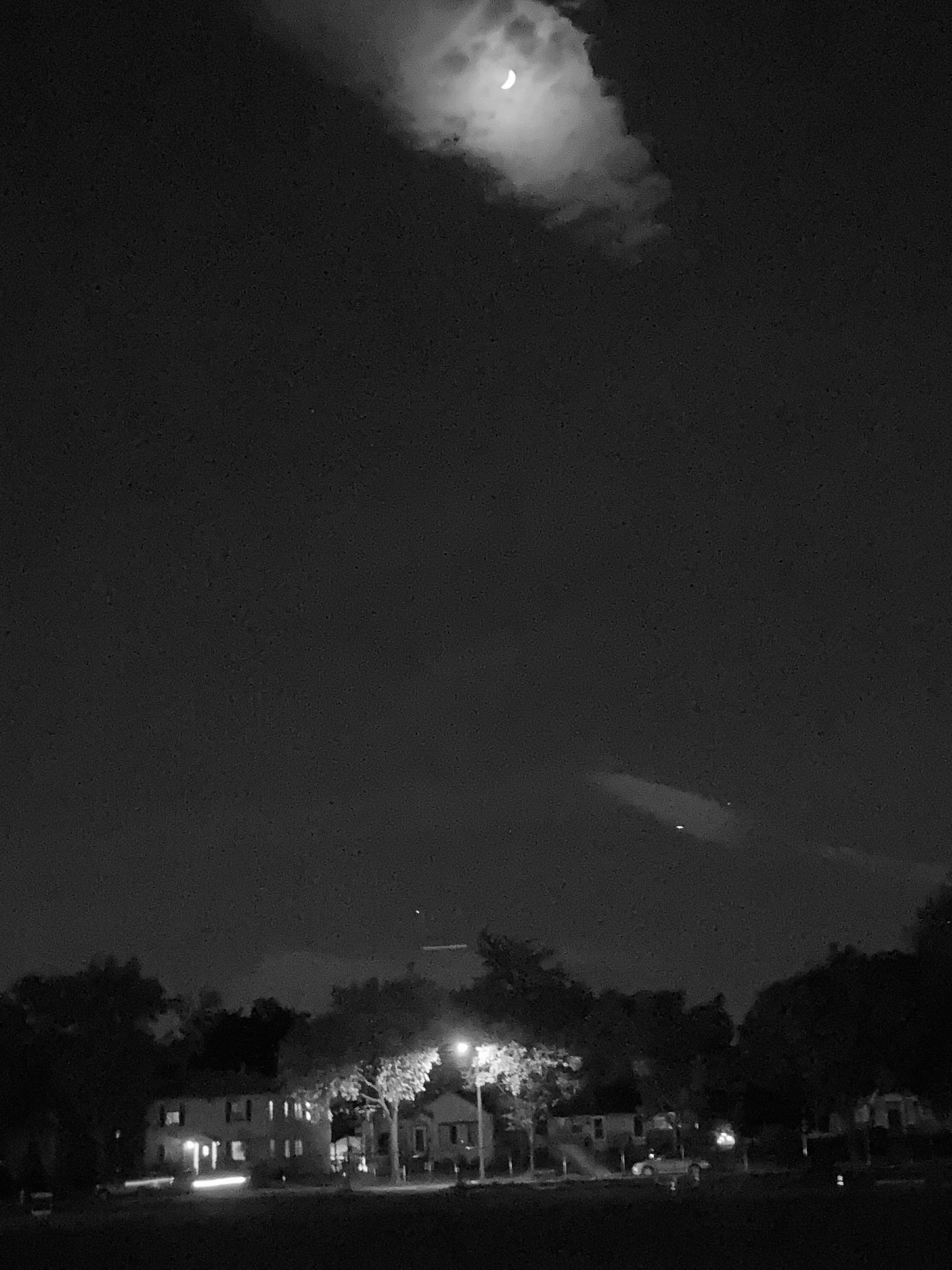
The moon is high above you.
We’re all here cause we love you.
And when you finally open your eyes and ears,
you’ll see and you’ll hear us sing.
La la la la la la, it’s a beautiful world and we’re all here.
—Jim Brinkman, “Beautiful World,” Hope (2007)
Integrity
“‘What’s required in these situations is a few folks standing up and giving courage to other folks,’ [President] Obama told Marc Maron last year. ‘We all have this capacity, I think, to take a stand.’ He added, ‘If convictions don’t cost anything, then they’re really just kind of fashion.’”
—Peter Slevin, “Out of Office,” The New Yorker (May 11 & 18, 2026)
Renewal
I guess I should begin again
I’m ready and I’m kind of relieved
To shed that skin
Could I persuade you to begin again?
—Mumford & Sons, “Begin Again,” Prizefighter (2026)
Composure
“Self-disclosure feels as good in our brains as eating chocolate or having sex.”
—Alison Wood Brooks, author of Talk: The Science of Conversation and the Art of Being Ourselves, as quoted by Lesley Alderman of The Washington Post in “Dealing With People Who Talk Too Much,” published in the Minnesota Star Tribune (June 8, 2025)
Freedom
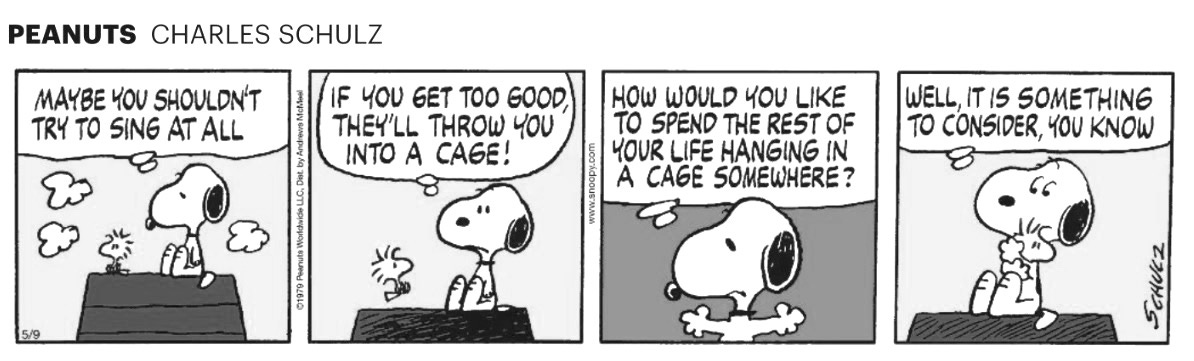
—As published in the Minnesota Star Tribune (May 9, 2026)
Sophistication
“As [U.S. Senator Tina Smith] thought about the pleas for [President] Obama to assert himself more in the public arena, she recalled a piece of wisdom often attributed to H.L. Mencken: For every complicated question, there’s an easy answer that’s almost always neat, plausible, and wrong.”
—Peter Slevin, “Out of Office,” The New Yorker (May 11 & 18, 2026)
Integrity
“I think you have to have accountability. For us, the thing that works best is total, brutal, between-the-eyes honesty. I never try to trick a player or manipulate them, tell them something that I’m going to have to change next week.”
—Gregg Popovich, then coach of the San Antonio Spurs, as quoted by Elise Devlin and Jayson Jenks, “Gregg Popovich is a Coaching Legend: He’s Also a Master of Tough Conversations,” The Athletic (June 22, 2025)
Forbearance
“As we walked through a museum dedicated to his faith in a perpetual, however jagged, path forward, I was reminded of something Michelle [Obama] said of her husband when she addressed the 2012 Democratic National Convention: ‘He reminds me that we are playing a long game here, and that change is hard and change is slow.’”
—Peter Slevin, “Out of Office,” The New Yorker (May 11 & 18, 2026)
Steadfastness
“When it appears that people other than yourself in your world do not act toward you as you would like, it is not due to reluctance on their part but a lack of persistence in your assumption of your life already being as you want it to be. Your assumption to be effective cannot be a single isolated act; it must be a maintained attitude of the wish fulfilled.”
—Neville Goddard, The Power of Awareness (Tarcher Cornerstone Editions, 23rd printing, 2012)
Love
“To care about the world you must love at least a piece of it. One person, perhaps even a landscape, might be enough.”
—Susan Neiman, Left is Not Woke (2023)
Ardor
“It had gone beyond her, beyond everything. He had thrown himself into it with a creative passion, adding to it all the time, decking it out with every bright feather that drifted his way. No amount of fire or freshness can challenge what a man will store up in his ghostly heart.”
—F. Scott Fitzgerald, The Great Gatsby (1925)
Forward
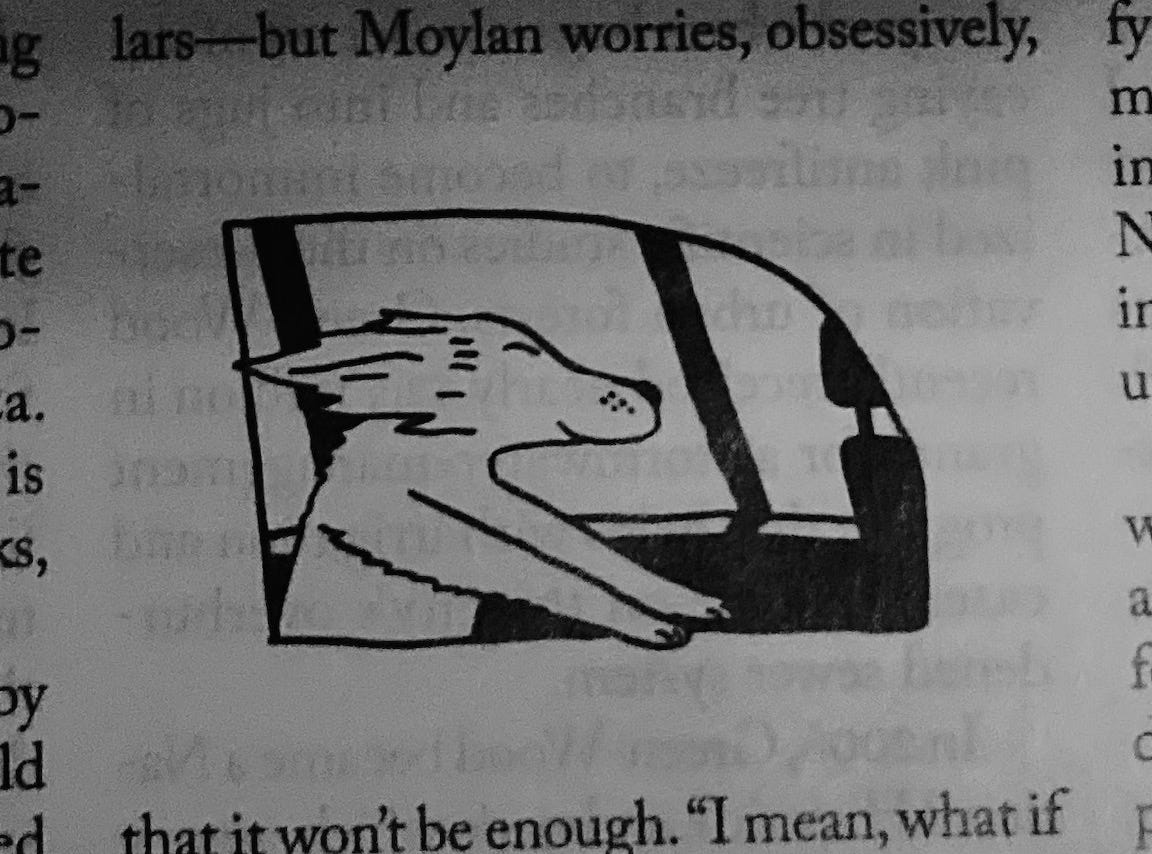
—Cartoon, The New Yorker (June 9, 2025)
Allegiance
Joseph Campbell: In matters of this kind, yes. The majority’s function in relation to the spirit is to try to listen and to open up to someone who’s had an experience beyond that of food, shelter, progeny, and wealth.
Have you ever read Sinclair Lewis’s Babbitt?
Bill Moyers: Not in a long time.
Campbell: Remember the last line? “I have never done the thing I wanted to do in all my life.” That is a man who never followed his bliss. Well, I actually heard that line when I was teaching at Sarah Lawrence. Before I was married, I used to eat out in the restaurants of town for my lunch and dinners. Thursday night was the maid’s night off in Bronxville, so that many of the families were out in restaurants. One fine evening I was in my favorite restaurant there, and at the next table there was a father, a mother, and a scrawny boy about 12 years old. The father said to the boy, “Drink your tomato juice.”
And the boy said, “I don’t want to.”
Then the father, with a louder voice, said, “Drink your tomato juice.”
And the mother said, “Don’t make him do what he doesn’t want to do.”
The father looked at her and said, “He can’t go through life doing what he wants to do. If he does only what he wants to do, he’ll be dead. Look at me. I’ve never done a thing I wanted to do in all my life.”
And I thought, “My God, there’s Babbitt incarnate!”
That’s the man who never followed his bliss. You may have a success in life, but then just think of it — what kind of life was it? What good was it — you’ve never done the thing you wanted to do in all your life. I always tell my students, go where your body and soul want to go. When you have the feeling, then stay with it, and don’t let anyone throw you off.
—The Power of Myth, pp. 146-147 (1991)
Risk
“... it’s another thing you think you can’t do. And maybe you can, maybe you can’t. That’s irrelevant. That’s irrelevant. You can or you can’t. What’s relevant is that you dive in. That’s relevant. Because however it comes out, it is worth it. Failure is just as worth it as success.”
Why?
“Because everything contains a reward of some kind. It’s your job to find it.”
—Jerry Seinfeld, “The Blocks with Neal Brennan” (May 2, 2024)
Amplification
“I had not a dispute but a disquisition with Dilke, on various subjects; several things dovetailed in my mind, and at once it struck me, what quality went to form a Man of Achievement, especially in Literature, and which Shakespeare possessed so enormously — I mean Negative Capability, that is, when a man is capable of being in uncertainties, mysteries, doubts, without any irritable reaching after fact and reason. Coleridge, for instance, would let go by a fine isolated verisimilitude caught from the Penetralium of mystery, from being incapable of remaining content with half knowledge.”
—John Keats, excerpt from “No. 45” (December 1817), The Letters of John Keats: 1814-1821 (Vol. I) edited by Hyder Edward Rollins
Courage
“The need to police group members’ beliefs so as to ferret out deviants, along with the fact that the expression of heretical opinion may be the best available evidence of deviance, creates the possibility for what I call self-censorship: members whose beliefs are sound but who nevertheless differ from some aspect of communal wisdom are compelled by a fear of ostracism to avoid the candid expression of their opinions.”
—Glenn Loury, “Self-Censorship in Public Discourse: A Theory of ‘Political Correctness’ and Related Phenomena,” Rationality and Society, Vol. 6, No. 4, p. 430 (October 1994)
Transfiguration
It careened and crashed while the others waved
And you waited in the sun so long when you only wanted shade
Let the old men laugh, let the old men say
That I’ve never done nothing that wasn’t out of love, baby
Now the weight that you carry seems such a heavy load
While you’re face down in the moment waiting to let go
Remember standing in the light
Remember crawling all the way
You paraded in the nighttime
For a clеan getaway
You were standing in thе water
But only up to your knees
But you know a strong current can always
Sweep you off your feet
You were waiting for the right time, but it could take so long
While you’re face down in the moment waiting to let go
Face down in the moment waiting to let go
You were following the blind
When they stole your name
You were planning a way out
When you lost your way
Bent to a hunch now
Like a broke-down show
Face down in the moment
Just waiting to let go
Face down in the moment waiting to let go
Face down in the moment waiting to let go
Keep waiting
Keep waiting
Keep waiting
You keep waiting on the night
You keep waiting on your pain
And every moment that you wait now
Is a moment slipped away
I think you’re gonna have to come out and face
All the fear you can’t explain
And all your life, you’ve been face down
Now it’s time for you to see
All your life, you’ve been face down
Now it’s time for you to see
All your life, you’ve been face down
Now it’s time for you to see
See it!
See it!
See it!
—Nathaniel Rateliff & The Night Sweats, “Face Down in the Moment,” The Future (2021)
Patience
“‘Never make a decision just to get something done,’ he says.”
—John McPhee, quoting Frank L. Boyden, “The Headmaster,” as reprinted in The John McPhee Reader (1992)
Availability
“I guess the main thing is having a true project with depth. Whatever the form, doesn’t really matter, as long as the depth is there.”
—Victor Wembanyama, as quoted by Jared Weiss, “Victor Wembanyama Wanted to Create a Spurs Fan Group: The Jackals Became So Much More,” The Athletic (January 15, 2026)
Civil Courage
“Hostility to such politics has been voluble and loud. Left-wing critics of tactical triangulation have maintained that this can be seen only as collaboration with evil. Right-wing impatience with the politics of compromise appears in the disquieting revival of Catholic ‘integralism,’ whose proponents favor capturing the state in order to impose a singular, and religiously inspired, vision of the common good. What unites these movements is a shared contempt for the moderate, who is dismissed as cowardly, unprincipled, or insincere: wimps who inexplicably hate winning.
“[Krista] Lawlor’s account helps explain why this contempt is so corrosive. When one side decides that the treaty was a mistake — that only total victory will do — it stops sending the costly signals that sustain shared ‘discursive’ space. ‘Better wrong with Sartre than right with Aron,’ the slogan used to go in the glory days of the French postwar left. Who wouldn’t prefer the glamour and the redemptive grandeur of the radical Jean-Paul Sartre to the pallid temporizing of the liberal Raymond Aron? But people like Aron have offered something other than the glory of commitment: a sense of imagination, of compassion, an awareness that your foes, too, have ideals that feel glamorous to them.
“In defending reasonableness, Lawlor is defending the exhausted majority — those who still want to live together on terms of mutual recognition. She is unlikely to persuade the most passionate of partisans. But she may perhaps give heart to the despised moderates, who may be starting to internalize their critics’ charges that their willingness to compromise is really just a failure of nerve.
“Think back to another culture-war moment. In the wake of the 1992 Los Angeles riots, the rapper and activist Sister Souljah asked, rhetorically, ‘If Black people kill Black people every day, why not have a week and kill white people?’ To a question about whether there were any good white people, she replied, ‘If there are, I haven’t met them.’ Bill Clinton, then running for President, reproached her when he spoke at Jesse Jackson’s Rainbow Coalition. Many on the left saw betrayal and calculation. Why not see it, instead, as a performance of reasonableness, a refusal to allow a minority position within one’s alliance to define the map of value for everyone else?”
—Nikhil Krishnan, “Start Making Sense: Being Reasonable as a Social Value,” The New Yorker (April 27, 2026)
Desire
“I went out very nice dinner last night and I enjoyed the dinner. I got the check at the end of the meal and I started thinking about the check-at-the-end-of-the-meal system. It’s not a real good system, I think. Money … if you think about it … is a very different thing before and after you eat. Before you eat, money has absolutely no value. You know? You sit down at the table and you’re like the ruler of an empire. More drinks! More appetizers! We must have everything immediately! This is the greatest meal of our lives! And after you eat — first of all, when you’re really full, you can’t remember ever being hungry ever in your life. You got the pants open, napkins destroyed, cigarette butt in the mashed potatoes — you know it’s not really festive — and you get the check and you’re like, ‘What is this? I don’t understand.’ People are always mystified by the check — aren’t they? They start passing it around the table. ‘Does this look right to you?’ We’re not hungry now; why are we buying all this food?”
—Jerry Seinfeld, Late Show with David Letterman (1989)
Calibration
“One thing you do learn with flying is, when you’re off course a little bit, my instructor always said, ‘small adjustments normalize the situation.’ In basketball, life, and basketball coaching, small adjustments and normalizing the situation as much as possible have a lot to do with problem-solving.”
—Rick Carlisle, as quoted by David Aldridge, “Pacers Coach Rick Carlisle Keeps Looking to Improve Himself in ‘Ultimate Crucible,’” The Athletic (June 4, 2025)
Cunning
“On February 14, 1986, during a game against the Trail Blazers, in an effort to both work on craft and fight tedium, [Larry] Bird played forty-eight minutes and scored 47 points using only his left hand. Explaining himself to the press, he said, ‘I’m saving my right hand for the Lakers.’”
—Rich Cohen, When the Game Was War: The NBA’s Greatest Season, p. 71 (2024, paperback edition)
Growth
“Why should you want to exclude from your life all unsettling, all pain, all depression of spirit, when you don’t know what work it is these states are performing within you? Why do you want to persecute yourself with the question of where it all comes from and where it is leading? You well know you are in a period of transition and want nothing more than to be transformed.”
—Rainer Maria Rilke, Letters to a Young Poet (Charlie Louth translation, 2011)
Wholeness
“All of us have what was given to us by nature, how we’ve been created or built. This is how I’ve been created and built. I was born, and since the day I was born, it was in my body that I was going to have a thrombosis someday. It’s also written that I’m having this height and I’m having this talent for basketball. Just like everybody in (our locker room). We were all born with a roll of the dice, and we just have to make the most out of it.”
—Victor Wembanyama, as quoted by Jared Weiss, “Victor Wembanyama Wanted to Create a Spurs Fan Group: The Jackals Became So Much More,” The Athletic (January 15, 2026)
Forward
“One of [Hal Mumme’s] favorite sayings was, Play the next play. The words were a combination pep talk and theory of life, perfectly aligned with his coaching philosophy. The gist was, life, like football, is a headlong dive into the future. There is no past, at least not one you should worry too much about. If you lose, let it go. Don’t panic. If you win, don’t be too satisfied. Play the next play. The future awaits. There are so many possibilities. And the moment was always better if the next play was an onside kick or a fake punt in one’s own end zone or a certifiable crazy attempt to throw a touchdown pass from one’s own 1-yard line. Because the Air Raid was such a malleable concept, there were any number of futures out there. Anything could happen, and if anything could happen, then there was no point in dwelling on the past. Play the next play.”
—S.C. Gwynne, The Perfect Pass: American Genius and the Reinvention of Football (2016)
Trust
“To some, ‘nirvana’ suggests bliss. More literally, it refers to the extinguishing of the mental fires that cause suffering. Today’s happiness comes from loosening your grip on an unhappy idea.”
—Holiday Mathis, Horoscope, Minnesota Star Tribune (February 4, 2026)
Simplicity
“The life they had together was one that neither of them had really imagined. They grew from passion to lust to a deep sensuality that renewed itself from moment to moment.
“‘Lust and learning,’ Katherine once said. ‘That’s really all there is, isn’t it?’
“And it seemed to Stoner that that was exactly true, that that was one of the things he had learned.”
—John Williams, Stoner (New York Review of Books Classics, 2006)
Sovereignty
“The energy of the central point is manifested in the almost irresistible compulsion and urge to become what one is, just as every organism is driven to assume the form that is characteristic of its nature, no matter what the circumstances. This centre is not felt or thought of as the ego but, if one may so express it, as the self. Although the centre is represented by an innermost point, it is surrounded by a periphery containing everything that belongs to the self — the paired opposites that make up the total personality.”
—Carl Jung, The Collected Works of C.G. Jung, as quoted in Individuation for Adult Replacement Children: Ways of Coming Into Being by Kristina E. Schellinski (2020)
Indomitable
“Don’t downgrade your dream just to fit your reality. Upgrade your conviction to match your destiny.”
—Stuart Scott, epigraph, Boo-Yah: A Stuart Scott Portrait (2025)
Guile
He gives out a lot of “false information.”
—Dave Randorf, television broadcaster, attributing the phrase to an opposing NHL coach who was speaking about the on-ice intelligence of Tampa Bay Lightning right wing Nikita Kucherov, during a game against the Detroit Red Wings on April 13, 2026
Confidence
Norman Dale (played by Gene Hackman): First of all, let’s be real friendly here, OK? My name is Norm. Secondly, your coaching days are over.
George (played by Chelcie Ross): Look, mister, there’s two kinds of dumb, uh ... the guy that gets naked and runs out in the snow and barks at the moon, and, uh, the guy who does the same thing in my living room. First one don’t matter; the second one you’re kinda forced to deal with.
Dale: Translate. That some sort of threat?
George: I don’t know why Cletus drug your tired old bones in here. He musta owed you somethin’ fierce. Fact is, mister, you start screwin’ up this team, I’ll personally hide-strap your ass to a pine rail and send you up the Monon Line.
[George angrily turns and storms out of the gym]
Dale: Leave the ball — will ya, George?
—Hoosiers (1986)
Forward
There’s a song that sailors know
Lost, alone and far from home
(I am on my way)
Golden galleons, golden guns
To find a place under the sun
(I am on my way)
There’s a song on the Sahara wind
That lifts you to your feet again
(I am on my way)
That dances on the clockwork stars
That pulses through a beating heart
(I am on my way)
—The Midnight, “Explorers,” Kids (2018)
Aliveness
“You can only understand anything that matters — dreams, neurotic symptoms, people, literature — by over-interpreting it; by seeing it, from different aspects, as the product of multiple impulses. Over-interpretation, here, means not settling for a single interpretation, however apparently compelling. The implication — which hints at Freud’s ongoing suspicion, i.e., ambivalence, about psychoanalysis — is that the more persuasive, the more authoritative the interpretation the less credible it is, or should be. If one interpretation explained Hamlet we wouldn’t need Hamlet anymore: Hamlet as a play would have been murdered. Over-interpretation means not being stopped in your tracks by what you are most persuaded by; to believe in a single interpretation is radically to misunderstand the object one is interpreting, and interpretation itself.”
—Adam Phillips, “Against Self-Criticism,” London Review of Books, Vol. 37, No. 5 (March 5, 2015)
Self-Trust
“Twenty-thousand natural-born underdogs roared the winner’s roar. The man who made the moment possible by refusing to do anything but what he loves to do smiled, and for just a few seconds his mind was present and accounted for. Then he ran up the concrete tunnel and back into the pleasure of thinking for himself.”
—Michael Lewis, “Coach Leach Goes Deep, Very Deep,” The New York Times Magazine (December 4, 2005)
Authority
“He felt himself at last beginning to be a teacher, which was simply a man to whom his book is true, to whom is given a dignity of art that has little to do with his foolishness or weakness or inadequacy as a man. It was a knowledge of which he could not speak, but one which changed him, once he had it, so that no one could mistake its presence.”
—John Williams, Stoner (New York Review of Books Classics, 2006)
Integration
“So when he got on the bus that morning, he didn’t think anything was imminent.
“Less than an hour later, Dosunmu got the word — he was on his way to Minnesota.
“‘I just felt like, if you knew the trade was going to happen, if you knew it was done the night before, or you knew it was close, it was no need to have me get on the bus if you the trade was going down,’ the 26-year-old [NBA] guard said.
“His feelings were all over the place. Born and raised in Chicago, [Ayo] Dosunmu was on this way out from his hometown team to a new situation in a contract year.
“When he got back to his Toronto hotel, he did what he always does when he gets emotional: broke out his journal and started writing. Not on a computer or his phone, but an actual composition notebook, ‘like in third grade,’ with a pen. He put the date and the time on the page, then he let is out.
“‘I wanted to make sure I embraced all my feelings. I didn’t want to bottle up anything,’ Dosunmu said shortly after the trade. ‘As the hours went on, I was able to understand it and be like: This is a great opportunity for me. Excited to be here with the Timberwolves.’”
—Chris Hine, “Wolves’ Dosunmu Pens New Chapter,” StarTribune (April 8, 2026)
Work
“He never knows exactly what the other players might be saying about him, but he knows what they say about Fitz: ‘They think his intensity is ridiculous.’ And maybe they do. Of course, one fringe benefit of laughing at intensity is that it enables you to ignore the claims that a new kind of seriousness makes upon you.”
—Michael Lewis, “Coach Fitz’s Management Theory,” The New York Times Magazine (March 28, 2004)
Wisdom
“Men of few words are the best men.”
—Shakespeare, Henry V (Act 3, Scene 2), as delivered by “Boy” during a production at the Guthrie Theater (May 12, 2024)
Self-Trust
“In Spanish there is a word for which I can’t find a counter-word in English. It is the verb vacilar, present participle vacilando. It does not mean vacillating at all. If one is vacilando, he is going somewhere but doesn’t greatly care whether or not he gets there, although he has direction.”
—John Steinbeck, Travels with Charley in Search of America (Penguin Classics edition, 1997)
Courage
“Freud’s biggest contribution to psychoanalytic thought might be his portrait of a persecutory, enigmatic, and disturbing unconscious. For Rorty, the Freudian id is another God term, a bad-faith bid to ‘delegate and outsource our purposes and out imagination and our intelligence to something beyond ourselves,’ as [Adam] Phillips puts it. Rorty, he writes, prefers to envision the unconscious as a team of partners or interlocutors, all of them ‘really useful, helpful, and informed.’ The prospect delights Phillips, but he’s skeptical: Does pragmatism’s redescription merely baffle our efforts to understand and transform our darker impulses? It’s when we refuse to face what we really want, he worries, that we grow pliant and manipulable, vulnerable to the lure of instant gratification and denied the chance to make something tonic out of our frustration.”
—Katy Waldman, “Listen to Yourselves,” The New Yorker (March 23, 2026)
Fulfillment
“… the mission of life is to live that potentiality. How do you do it? My answer is, ‘Follow your bliss.’ There’s something inside you that knows when you’re in the center, that knows when you’re on the beam or off the beam. And if you get off the beam to earn money, you’ve lost your life. And if you stay in the center and don’t get any money, you still have your bliss.”
—Joseph Campbell (with Bill Moyers), The Power of Myth, p. 285 (1991)
Self-Worth
“Think, dear sir, of the world inside you — be it remembrance of your childhood or longing for your future. Only be attentive to what is arising in you and value it above all that you notice around you. Your innermost experience is worthy of all your love; you must focus your work on that and not waste too much time or courage explaining your position to anyone else. Why do you need to?”
—Rainer Maria Rilke, Letters to a Young Poet (Anita Barrows and Joanna Macy translation, 2021)
Boldness
“Yes, my advice to you is to take risks in your life — that’s the best thing I can tell you. And I don’t mean something like walking across a highway blindfolded.
“When I was in junior high I had a part-time summer job at the Walter Mackenzie Planetarium in Nova Scotia.
“I would change lightbulbs that were the stars. That’s how I first got interested in astronomy.
“I worked my way up to that job and first had to change the bulbs in the lobby.
“In fact, now whenever I’m in a lobby and look up at the lights in the ceiling I can make out a simple solar system.
“My father wanted me to be an electrician but from working at the planetarium I got it in my head that I would love to be an astronomer even though I thought it would never really happen.
“Like a kid wanting to be a baseball player or an astronaut. Although I couldn’t really want to be an astronaut because when I was a kid there were no astronauts.
“But at least I wanted to try. Because I thought what if I end up being 50 years old selling insurance in Wyoming and always wondering what would have happened if I had tried it.
“Not that there’s anything wrong with selling insurance in Wyoming.
“So I took the risk to pursue being an astronomer and I’ve had this whole life and career because of it.
“That little tiny fork in the road changed everything.”
—A fictional Carl Sagan, speaking to the 7-year-old title character of Harold, p. 228 (2023) by Steven Wright
Control
“Don’t be afraid of verbal abuse or criticism.
“Only the morally weak feel compelled to defend or explain themselves to others.
Let the quality of your deeds speak on your behalf. We can’t control the impressions others form about us, and the effort to do so only debases our character.
“So if anyone should tell you that a particular person has spoken critically of you, don’t bother with excuses or defenses. Just smile and reply, ‘I guess that person doesn’t know about all my other faults. Otherwise he wouldn’t have mentioned only these.’ ”
—Epictetus, Manual for Living: A New Interpretation (Sharon Lebell, 1994)
Persistence
“‘But there’s no remaking reality,’ he said, softly rubbing [his daughter’s] back and stroking her hair and rocking her gently in his arms. ‘Just take it as it comes. Hold your ground and take it as it comes. There’s no other way.’”
—Philip Roth, Everyman (2006)
Transformation
Vincent (played by Tom Cruise): “Hey, Eddie, what are you going to do when I kick your ass?”
Fast Eddie Felson (played by Paul Newman): “Pick myself up and let you kick me again.”
Vincent: “Oh, yeah?”
Eddie: “Yeah ... Just don’t put the money in the bank, kid. Because if I don’t whip you now I’m going to whip you next month in Dallas.”
Carmen (played by Mary Elizabeth Mastrantonio): “You mean Houston. There’s nothing coming up in Dallas.”
Eddie: “Houston. Dallas. And if not then the month after that in New Orleans.”
Vincent: “Oh yeah? What makes you so sure?”
Eddie: “Hey: I’m back!”
—The Color of Money (1986)
Collected
“The image of the dummy, the hick, is one more thing that [Larry] Bird uses to his advantage, like his jump shot, or, more to the point, his head-fake. ‘Like I tell people,’ he says, ‘I’m not the smartest guy in life, but on the basketball court I consider myself an A-plus. Not that I’m dumb. I can keep up with 90 percent of the people in this world. I just don’t explain myself to people. I want to keep ‘em guessing. The way they take me is the way they take me.”
—John Papanek, “Gifts That God Didn’t Give,” Sports Illustrated (November 9, 1981)
Purpose
“‘Do not attempt to spare my feelings,’ returned Cronshaw, with a wave of his fat hand. ‘I do not attach any exaggerated importance to my poetical works. Life is there to be lived rather than to be written about. My aim is to search out the manifold experience that it offers, wringing from each moment what of emotion it presents. I look upon my writing as a graceful accomplishment which does not absorb but rather adds pleasure to existence. As for posterity — damn posterity.’”
—M. Sommerset Maugham, Of Human Bondage, Chapter XLV (Penguin Classics edition, 1992)
Resolve
I’ve make mistakes
And I’ve been hard hit
I say so what
So what if I did
I’m the clear eyed
I’m the comeback kid
Start it over
Start it over again
I’m the clear eyed
I’m the comeback kid
—The Midnight, “Comeback Kid,” Endless Summer (2016)