


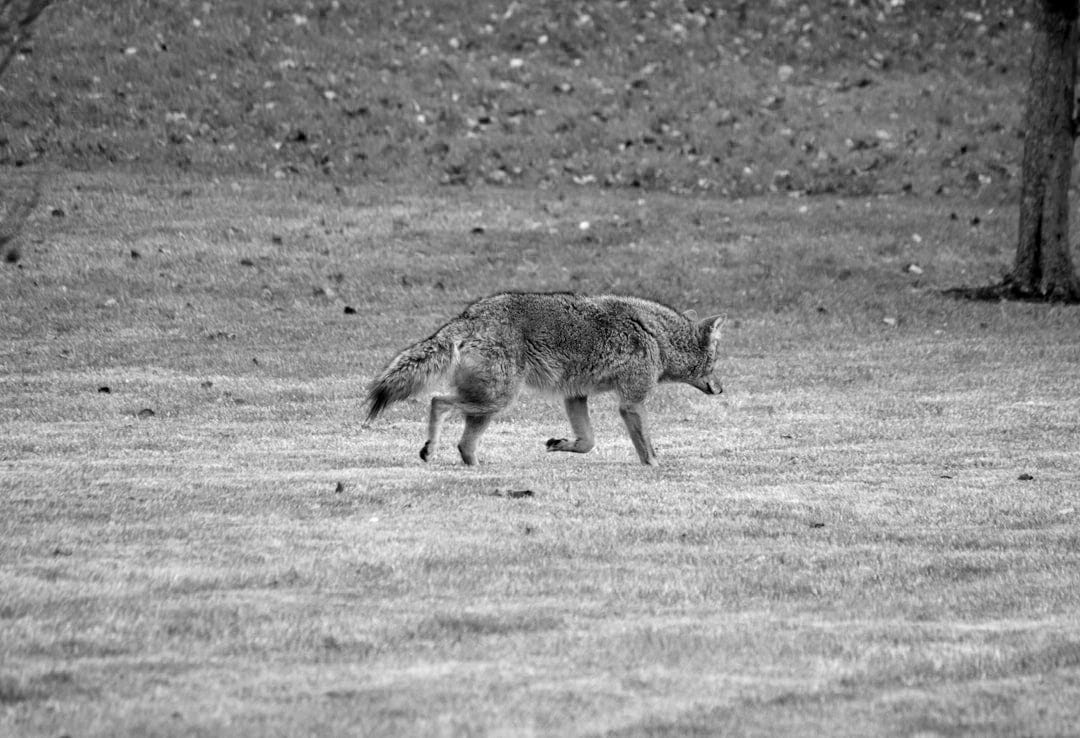
At 6:30 on a misty morning, as I walked along the parkway, in the distance appeared a creature that at first was a fox but then grew to the size of a coyote. This coyote jaunted parallel to me. I was on the sidewalk; the coyote was on the grass-covered median between rows of old trees. I happened to have my phone with me and I took a 22-second video of this encounter. Or so I thought. Once home, I saw the video didn’t take. I somehow managed to film 22 seconds of compelling footage of the sidewalk.
What — if anything — shall I make of this encounter?
In indigenous traditions, coyotes that populate North America are considered trickster-creators. That is, creatures who move between worlds. As they cross boundaries, they open new possibilities. At first, I wondered if I should be afraid; I don’t have much experience with such animals. But quickly I sensed that this beast was not a threat to me. Neither, it turns out, did it feel vulnerable in my presence. The coyote clearly knew I was there and didn’t much care. Certainly, it didn’t immediately flee. Coyotes, it is said, are identified neither primarily as predator nor prey. They naturally cross boundaries. They aren’t easily pinned down or, at least in my case, captured.
To summarize:
My mind was initially deceived by the shape-shifting figure before me.
The animal that came into my awareness is a boundary-breaker.
When you break boundaries, you create new environments.
The coyote didn’t come at me. The coyote didn’t run away from me. The coyote moved along side me.
I tried to “capture” this experience animal but failed. Because of course. Even here, this attempt to capture the moment shows the futility of the exercise.
There are no conclusions here. You observe. You allow. You process. And, like the coyote, you keep moving.