


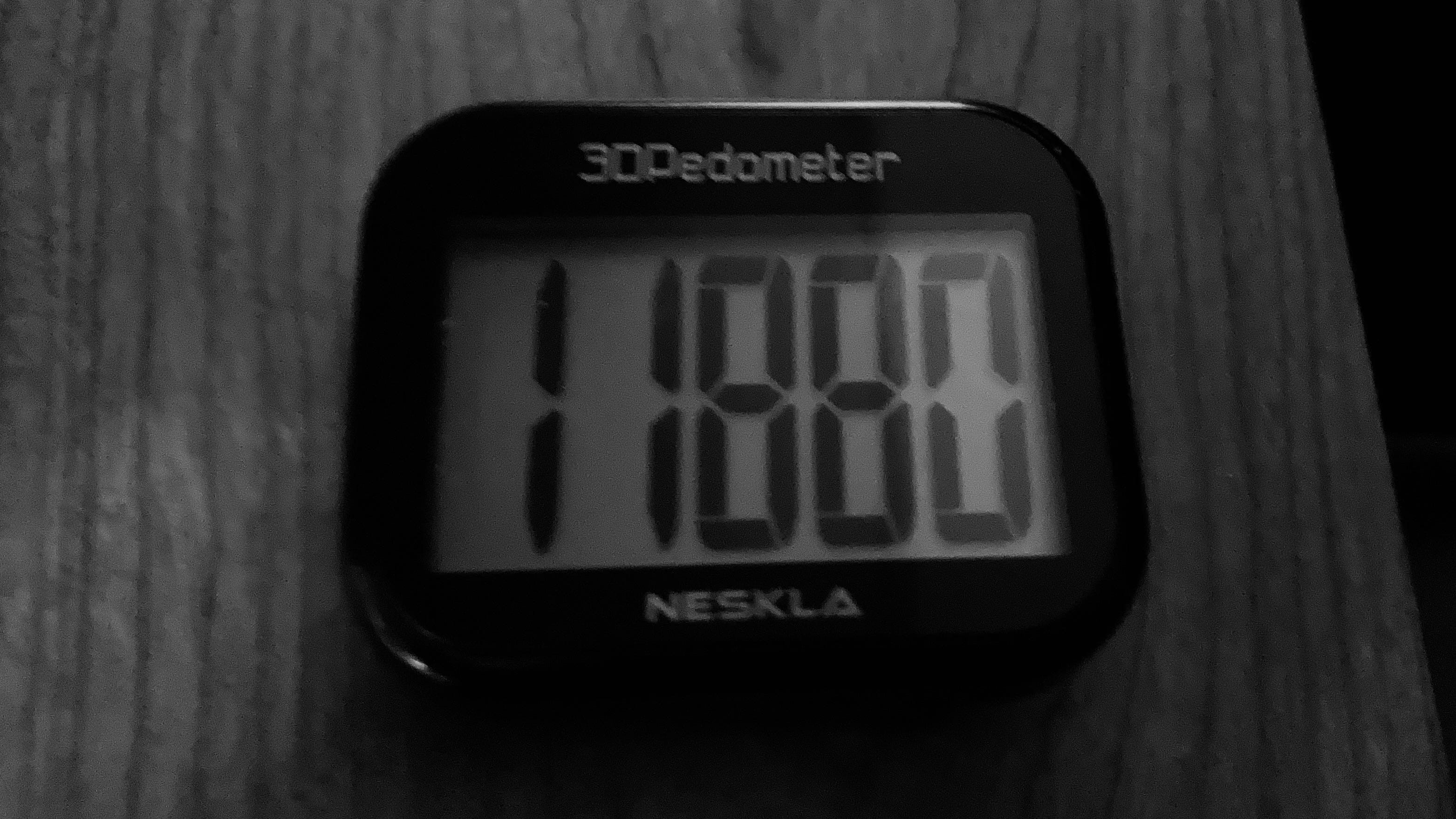
The other night I dropped my pedometer on the ground — and I didn’t know where or when I did. The downside of noise-canceling headphones is that they work during moments you would like to register with sound.
Instead, when I reached into my pocket and didn’t feel the pedometer registered with distress. I knew immediately how the pedometer escaped my person: my Vuori shorts (a clothing brand, by way, that quickly fails at the seems — just saying) had a hole in the left pocket. I didn’t think the hole was large enough for the pedometer to fit through. Usually, I would put the pedometer in my right pocket but what I did know about that hole is that definitely my keys would slip through and I didn’t want both keys and pedometer in same pocket. I couldn’t hear myself but I still didn’t want to sound like a human maraca.
On one hand, the pedometer wasn’t expensive — an analog counter of the most rudimentary kind. Not only does this little display with a cheap clip not come with an app or a wire, there isn’t even an on/off switch. There’s one button, which, when pressed and held, zeros out the numbers. Otherwise, the count goes up when you move and the count stays put when you do. I carry this low tech gizmo most every where I go.
There’s something about the marvel of the mind — that we can experience times and places from our past; we can imagine things that aren’t there; we can create, plan, reflect, analyze, project, and, feel a sense of oneness with other living things. That’s the mind. The brain itself … well, that’s rather simple. Food. Sex. Sleep. The brain is pretty straightforward in its pursuits and desires. I carry a counter in my pocket and this counter gives me one piece of data — and one piece of data only — that has become essential to my satisfaction and motivation during recent surgery recovery and beyond. Now that I’ve reached a place where exercise is fundamental not just to recovery but to everything else that I want to build and maintain the rest of my years.
It’s the most basic form of psychology: I move more when I know the number will reflect my efforts. I feel more satisfied when the number is higher. Practically, this isn’t nothing. I have come to know, for example, that I am likely to sleep better if the day’s total is 14,000 than if it’s 8,000. But — stepping back from this step counter — you might say I’m no different than I was as a boy when there was a score on a board. When the number on the scoreboard told me my team was ahead, I was content. Simple tracking — of steps or food or whatever is important to one’s health — affects behavior. In some cases, significantly.
(Of course, one could make a case that total steps walked is an incomplete picture of fitness and they would certainly be right.)
And, well, when the whereabouts of the device that gives me this boost of self suddenly was gone — and there was also the awareness that steps had been taken, un-registered (gasp!), in the interim — that gave me a different kind of start. Well after dark, I had only a phone flashlight to guide my way. At first, I thought how unlikely it would be that I would find the thing. I figured I could buy another one. (At least for now; who knows how long they will continue to make devices that don’t give companies data about us.) Again, this wasn’t a financial concern. But how long would it take for me to obtain a replacement? Probably not many days but certainly I wouldn’t have one in time for the remainder of this walk and probably not for the entirety of multiple others.
Yet, after the initial sense of things subsided, something told me that I would, in fact, find it. As I retraced my steps I told the rabbits, “I will find it and it will be glorious.”
Retracing my steps with my phone flashlight low to the ground I did find it and did experience my moment of elation. My answer to the Tom Hanks character Check Noland’s “Wilson” in the movie Cast Away was back in my possession, gripped in my hand rather than dropped into my pocket, the numbers again went up and all was right in Magic City.
My steps were suddenly lighter and easier — and proved another simple psychology hack: Knowing what you’re looking for gives you a chance to find it. In that way, I had lost some steps off my count for the day but I had gained a different sort of satisfaction, as I walked slowly in the dark with hope that I would, as I did, find in the shadows something uniquely useful to me. The best metaphors are the ones that write themselves.