


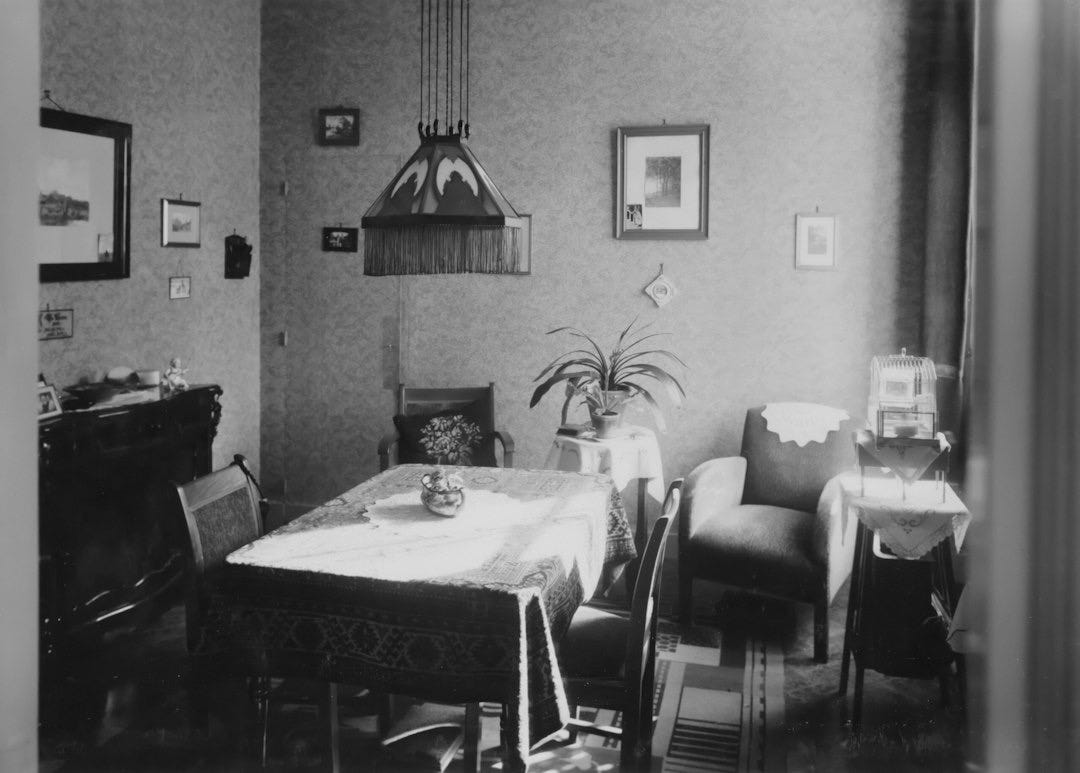
Over the weekend I took in a local production of Arthur Miller’s The Price (1968).1 I had not before seen this two-act play ostensibly out about the price of furniture that’s really about the price of our decisions.
When he was a young man, Victor Franz gave up going to college in order to support his father, an economic casualty of the Great Depression. Now, years after his father passed away, Victor returns to the site of his sacrifice to finally sell his parents’ furniture. Victor’s wife, Esther, his brother, Walter, and a pugnacious and philosophic, 89-year-old furniture appraiser are the other on-stage characters in this four-actor story. Unseen characters include the ghosts of the deceased mother, who liked to play the harpsichord, and the father, who was either helpless or manipulative, depending on which son you ask.
As Victor finally settles the estate, he’s forced to consider his past choice and he’s the on the receiving end of a nearly three-decade chain reaction. After 28 years as a policeman, Victor, who always wanted to complete and make use of a college degree in the sciences, is haunted by that missed opportunity and paralyzed by his next big decision: what to do with what remains of his life. He’ll soon be 50. As he sees it, there are no good answers; he’s too late to become the person he wants to be.
The first act is a witty appraisal of the stuff onto which we project our memories and the second act is a powerful appraisal of family dynamics that shaped those projections. After years of estrangement, Walter, an affluent, educated doctor, and Victor, the younger of the two brothers, confront each other and their shared past.
Dramas are written to be performed but this play feels like one that could be as powerful on the page, as the entire story unfolds exclusively in the old apartment and in the characters’ imaginations.
The Price isn’t known for its quotable lines the way Miller’s Death of a Salesman is. But among those that struck me, the feisty Victor at one point laments to Walter about life: “It’s impossible to know what’s important.” If we’re lucky, we’re blessed with enough awareness about the ways in which our decisions altered our course. But we couldn’t possibly know then what would be the ramifications of those decisions. It’s not until long after the fact that we can have the sense of clarity we wish we had at the time. We want to go back and choose differently. How tragic would life be if we couldn’t see our mistakes. And how sad life is because we can.
Walter hasn’t led a flawless or blissful life himself — his marriage failed and he spent the better part of three years in the hospital — yet when he grabs Victor by the collar and tells his brother that his past sacrifice was a choice rather than a necessity you can feel years of life vanish like faucet water down the kitchen sink.2
Yet Walter has shown up not to run his brother down but rather to lift him up. He wants to make amends. He’s offers him a good job and the chance to know one another again. He wants them to become friends.
As the brothers try to reach one another they demonstrate how more than one thing can be true. They are respective vessels for opposite tales of the same history — and both of the stories are true. You want the brothers to embrace and finally find peace but Miller’s script resists easy answers.
When you examine life in this way — looking at a hole in which you thought there was love and also a tunnel to the future without hope … the word “waste” comes to mind. I read that Miller wrote The Price (1968) in response to the Vietnam War. I don’t know if that’s what he meant but it fits.
I don’t think works of art can or should be reduced to a single message; that ruins their experience and limits their capacity to affect us. Yet, as I reflect on my response to the play,3 one thing that keeps coming up is the notion that it’s important to face the past but not hold too tight a grip on what was. Often, we did what we did for reasons we couldn’t then know. Victor is right: It’s impossible to know what’s important. He says it as a lament but it could be seen as grace. We can’t know.
That is, until we do. Once we know, we get to decide whether we’re going to move toward that thing or we’re not.
As humans, we’re prone to repeat the same choices in different contexts and time. While circumstances change, our wiring doesn’t; what matters to us doesn’t. That is, unless we have the self-awareness to break the pattern.
It’s late evening as I write these words. It’s the fourth day of the 11 in a row in which I promised myself I would post. I’m tired at this, the end of a work day. I could wait to post until tomorrow, when my eyes would be clearer and the above would have a greater chance to be something more than it’s going to be. Except that’s what I’ve done in the past and I’m trying to break that pattern. I want to move toward new. Given how few people will read this, is this decision — to post or not, I mean — important? I don’t know. What I know sure is only that, at this moment, the decision feels not unimportant. And that’s all of my truth I get access to right now.
My first visit to The Gremlin Theatre in Saint Paul.
Of the four characters, the part of Walter is the smallest in the play. Even so, I thought David Mann, who played the elder brother, turned in the most convincing performance.
Which was I grateful to see. I hope to have occasion to go back to The Gremlin.